CMC Director Seth Cluett's Installment Included in Outside Linear Time
Outside Linear Time, an art and tech exhibition is the Spring 2026 exhibition programmed for the Harvestworks Art and Technology Program Building on Governors Island.
Outside Linear Time– is an exhibition of five artists who are exploring tactile landscapes where listening becomes a means of navigation, a re-structuring of one-self and of our systems of human and ecological resilience. Non-linear narratives explore materiality and physics, conditions of censorship and surveillance and epic tidal shifts. Selected by the Harvestworks arts committee and director emerita Carol Parkinson, the works employ mechanical sound recording and reproduction, video processing and stop motion imaging and sound objects presented through binaural and multichannel sound, video and audience activated artworks.
The exhibition features works by:
Itziar Barrio, Qiujiang Lu, Sara Stern, Seth Cluett, and Zorica Čolić
ARTWORKS
‘this meshwork of interwoven lines’ by Seth Cluett is a sound installation addressing addressing environmental collapse and ecological strain, Seth Cluett’s new installation, ‘this meshwork of interwoven lines’ presents silent and sounding works that collapse the landscape into layered juxtapositions, pointing up systems of resilience at work in the natural world that thrive despite the incursion of humanity.
“What then becomes of our concept of environment? Literally an environment is that which surrounds. For inhabitants, however, the environment does not consist of the surroundings of a bounded place but of a zone in which their several pathways are thoroughly entangled. In this zone of entanglement – this meshwork of interwoven lines – there are no insides or outsides, only openings and ways through.”
-Tim Ingold
Tapescape, 2026 by Qiujiang Levi Lu 卢秋江 Magnetic tape, acrylic panels, custom playback device, four-channel sound Tapescape is an interactive sound installation that reimagines magnetic tape as a spatial surface for composition. Rather than treating tape as a linear medium for fixed playback, Lu records and arranges sound on tapes across flat acrylic panels, allowing composition to exist as a field of directions, densities, and gestures distributed in space.
Visitors are invited to use a custom-built playback “pen” to draw across the surface of the work. By moving the pen perpendicular to each taped composition, they activate recorded sounds through a four-channel speaker system. As different paths are traced across the acrylic panels, sounds emerge, recede, and shift through the room, making each encounter distinct. Listening becomes an active process of searching, following, and orienting: rather than receiving a predetermined sequence, the audience uncovers the composition through touch, movement, spatial and embodied attention.
The work considers how sound might be composed and encountered outside of linear time. In Tapescape, recording becomes a tactile landscape and listening becomes a means of navigation.
The moment when you stop looking for them by Itziar Barrio is a cross-media installation including film, VR, and robotic sculptures. The animation and VR components present a speculative fiction dialogue-turned-flirtation between the philosopher Plato (c. 428–423 BC, died 348/347 BC) and the mathematician Euclid (fl. 300 BC) on reality, representation and form. It deploys Unity, Blender and other digital tools to explore materiality and physics with rendered objects. Original footage of Plato’s Academy in Athens, Orpheus’ cave in Lesbos, and the Aegean sea are mixed with a collaborative text generated using large language models and different materialities of corporate and non-corporate algorithms. Flushing, one of the robotic sculptures, is a choreography of materials, motors and inflation-disinflation movements using Arduino, concrete and oil slicks of Spandex. The moment when you stop looking for them reflects on our current state of technological “becoming” from a human de-centering point of view, and on how the past connects with the future.
Algorithms these days are everywhere- shaping our realities, jobs, and relationships. The moment when you stop looking for them is part of the new long term multimedia project by Itziar Barrio exploring the origin of algorithms and their influence on western logic, alongside poetry as a model of dissent.
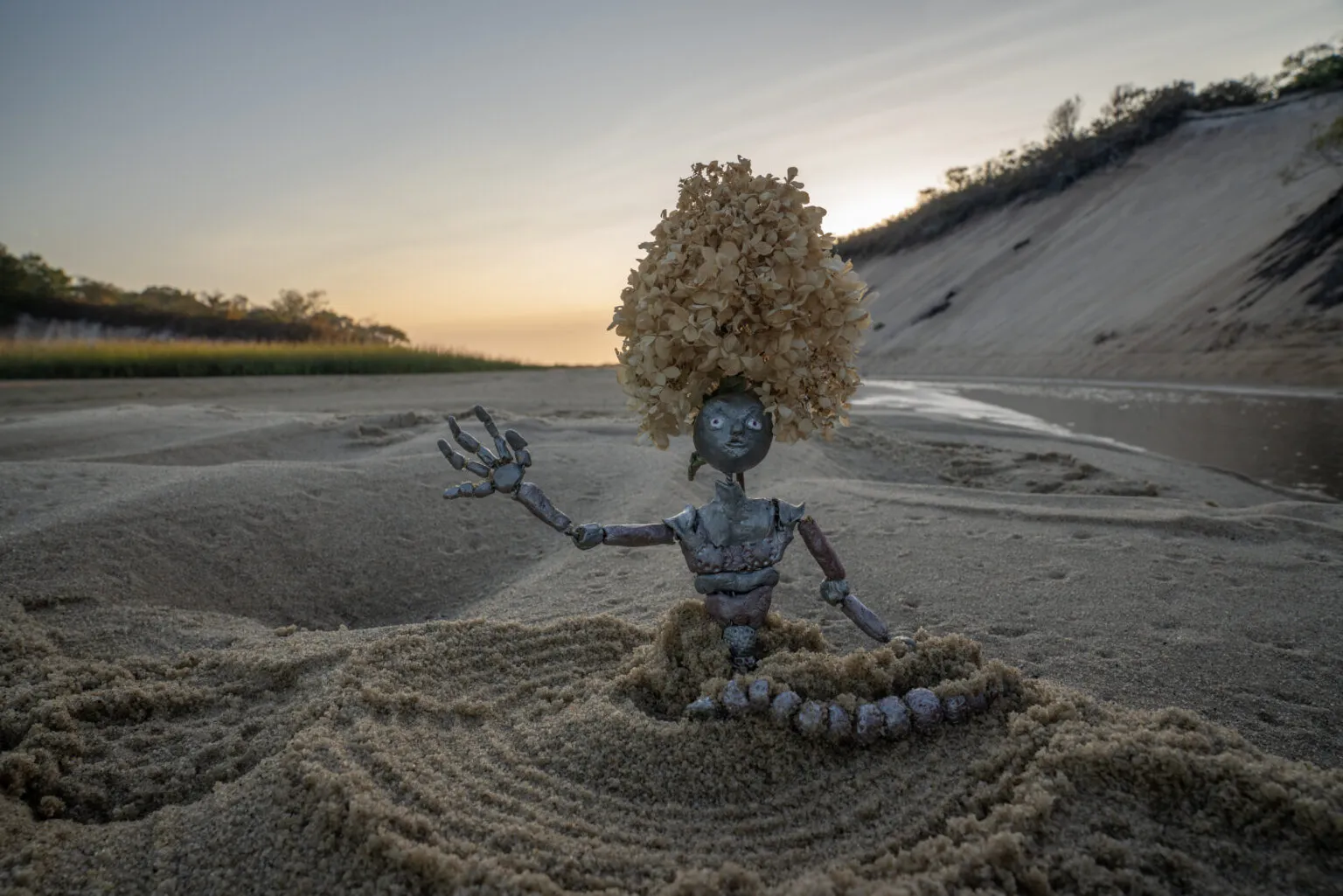
“MARSH” by Sara Stern is an experimental stop motion animation filmed in a saltwater marsh in Provincetown, MA (a town at the tip of Cape Cod, Massachusetts with rich queer and artistic history). Over the course of a full tide cycle, the site transforms from a desert-like environment to a full ocean scape, and back again. “MARSH” responds to these epic tidal shifts and this site of constant change with improvised stop motion.
Throughout the video, fantastical characters perform and sing on behalf of the marsh, as if performing a fragmented ecological opera. Several of the puppets are made out of marsh materials, such as peat (the spongy, mud-like, partially decomposed matter that defines marshlands and is a major carbon-sinking force) and marsh hay (which is swept to the edges of the marsh with each high tide). The “MARSH” soundscape integrates field recordings of the marsh from above and below water, granular synth experimentation with samples of field recordings, theremin, and voice.
“MARSH” explores the marsh as a site where human activity is metabolized but never fully digested. (If there is a nuclear disaster on the other side of the planet, traces of nuclear material can be found in Provincetown’s marsh in the sedimentary layer from that year). An Ursula-inspired character sings “In the marsh, in the marsh, all their cruelty, we’re gonna eat it, eat it, eat it, eat it.” The marsh becomes a kind of mirror to human activity, which is a theme throughout the video: characters gaze upon themselves in mirrors, send mirrors out to sea, or find their reflections in the rising tide.
“A Voice and Nothing More” by Zorica Čolić is a binaural sound installation that examines the psychological effects of living under conditions of increased censorship and surveillance. It considers how the awareness of being watched or listened to reshapes perceptions of the self and the other, blurring distinctions between what is experienced, imagined, remembered, or repressed.
Structured around three loosely related narratives – Animal, Voice, and Dream – the work traces the inner thought processes of an individual negotiating feelings of safety, exposure, and threat. The installation responds to the space itself, including an existing hole in the ceiling. One narrative unfolds as a reflection on public and domestic safety, layered with anxiety about intrusion and culminating in the imagined aftermath of an animal falling through the ceiling. The second moves from a fear of speaking under censorship to questioning whose voices are heard, developing into a conflicted reflection on truth as both eroded and necessary. The third takes the form of a dream, oscillating between flight, the fear of capture and falling, and a sudden, disorienting sense of freedom. Reality, dream, and paranoia intermingle, opening the possibility of release or transcendence.
The script draws from literary sources, fables, political speeches, as well as philosophical and psychoanalytic discourse on truth, freedom, and otherness. Inspired in part by Franz Kafka’s short story The Burrow – an allegory of a creature obsessively securing its dwelling – the work explores the tension between the pursuit of safety and the inevitability of vulnerability. The title references Mladen Dolar’s book A Voice and Nothing More, which examines the complex role of the human voice in culture.
The installation includes sculptures from the series Partial Objects, such as Not Without a Hair on a Tongue, which draws on the Serbian idiom “to speak without a hair on one’s tongue,” meaning to speak directly and without restraint.